Schizophrenia is a chronic mental
disorder that affects a person’s feelings, thoughts and behavior.
The main
symptoms that include delusions and hallucinations are worrying and make it
difficult for one to do daily activities.
disorder that affects a person’s feelings, thoughts and behavior.
The main
symptoms that include delusions and hallucinations are worrying and make it
difficult for one to do daily activities.
Diagnosis of schizophrenia involves
excluding other psychological and mental health disorders and determining that
symptoms are not caused by drug addiction, substance abuse or other medical
condition.
Your doctor may use different diagnostic tests – such as CT scans,
MRI or blood tests – to rule out neurological disorder and physical illness as
the cause of the symptoms.
The goal of schizophrenia treatment with
antipsychotic medications is the effective management of psychotic symptoms and
warning signs at the lowest possible dose.
excluding other psychological and mental health disorders and determining that
symptoms are not caused by drug addiction, substance abuse or other medical
condition.
Your doctor may use different diagnostic tests – such as CT scans,
MRI or blood tests – to rule out neurological disorder and physical illness as
the cause of the symptoms.
The goal of schizophrenia treatment with
antipsychotic medications is the effective management of psychotic symptoms and
warning signs at the lowest possible dose.
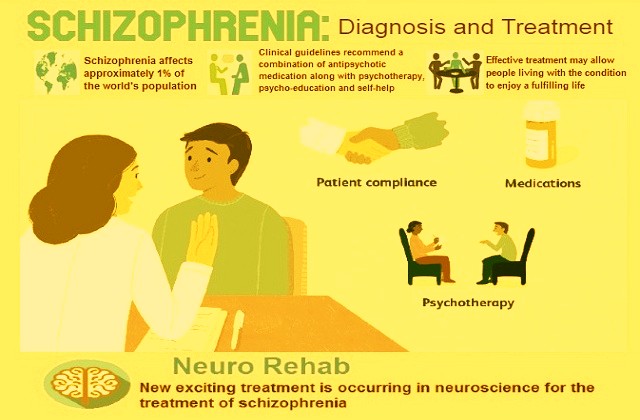 |
| Schizophrenia – diagnosis and treatment |
Schizophrenia – Diagnosis, and Treatment: Types of Therapy and Antipsychotic Medication
What is Schizophrenia?
Schizophrenia is a psychological disease and
disorder of the mind, known for thousands of years, and is widespread in women
usually more than men.
A person with schizophrenia has difficulty distinguishing between what is real and what is not. The period in which the disease is seen is the
stage between adolescence and the age of 30 years, and men are infected earlier
than women.
According to studies, the spread of the disease is more common in
industrial cities than in the countryside or villages.
disorder of the mind, known for thousands of years, and is widespread in women
usually more than men.
A person with schizophrenia has difficulty distinguishing between what is real and what is not. The period in which the disease is seen is the
stage between adolescence and the age of 30 years, and men are infected earlier
than women.
According to studies, the spread of the disease is more common in
industrial cities than in the countryside or villages.
(adsbygoogle = window.adsbygoogle || []).push({});
Causes of Schizophrenia
Scientists have not known the main cause of this disease to the
date, but what specialists have suggested is that schizophrenia is caused by
several factors such as genetic, social, and psychological factors.
date, but what specialists have suggested is that schizophrenia is caused by
several factors such as genetic, social, and psychological factors.
There are a number of factors that inevitably lead to
schizophrenia and schizoaffective disorder in neurotransmitters, or even in the
brain itself.
The fact is that these factors are not an exact reason for this
disorder but they may lead to schizophrenia, these factors are important
because prevention is better than treatment, and knowledge of the causes and
factors and understanding of their impact contribute significantly to the
treatment.
These factors are:
schizophrenia and schizoaffective disorder in neurotransmitters, or even in the
brain itself.
The fact is that these factors are not an exact reason for this
disorder but they may lead to schizophrenia, these factors are important
because prevention is better than treatment, and knowledge of the causes and
factors and understanding of their impact contribute significantly to the
treatment.
These factors are:
Genetic factors: One of the most important causes of this serious psychological disorder,
where studies were conducted to prove the role of inheritance and its impact on
the disease, as the proportion of infection increases the relationship with a person in this disease.
Regardless of the importance and high proportion of
this factor, researchers believe that it is a genetic tendency to be effective
with the cause of the disease and the availability of other factors.
where studies were conducted to prove the role of inheritance and its impact on
the disease, as the proportion of infection increases the relationship with a person in this disease.
Regardless of the importance and high proportion of
this factor, researchers believe that it is a genetic tendency to be effective
with the cause of the disease and the availability of other factors.
Pregnancy and childbirth: Studies have shown that a large proportion of schizophrenic
patients have been affected by complications in pregnancy and childbirth. This
has been seen as a factor in getting ready for the disease but not directly
causing it.
patients have been affected by complications in pregnancy and childbirth. This
has been seen as a factor in getting ready for the disease but not directly
causing it.
Psychological factors: The conflicts and problems of maturity that a teenager may
face and experience repeated failures or severe psychological trauma in early
childhood and make the teenager return to a safer stage to satisfy him, or
resort to the imagination to escape from reality.
It is important to note that
these factors are not only associated with the environment but are also
affected by the nervous system and the endocrine system.
face and experience repeated failures or severe psychological trauma in early
childhood and make the teenager return to a safer stage to satisfy him, or
resort to the imagination to escape from reality.
It is important to note that
these factors are not only associated with the environment but are also
affected by the nervous system and the endocrine system.
Social factors or family problems: Studies have shown that the role of the family affects
schizophrenic patients; patients living in families with a high degree of
emotional change, hyperactivity, criticism, and aggression are most likely to
relapse and these factors increase the chance of disease and impede its
improvement.
schizophrenic patients; patients living in families with a high degree of
emotional change, hyperactivity, criticism, and aggression are most likely to
relapse and these factors increase the chance of disease and impede its
improvement.
Substance abuse and Addiction: Several studies have shown that people who smoke cannabis
are more likely to develop schizophrenia than others and that those taking alcohol, sedative, and steroids regularly
often get sick as a result of the use of these drugs.
are more likely to develop schizophrenia than others and that those taking alcohol, sedative, and steroids regularly
often get sick as a result of the use of these drugs.
Chemical factors: Patients with schizophrenia suffer from excessive
sensitivity to dopamine receptors.
Dopamine is a neurotransmitter that helps to
transfer nerve signals between the neuron and the other.
This has led
scientists to say that the disease may be caused by a defect in the brain
chemicals, but this theory is a secondary factor, as the excessive dopamine in
the brain leads to the narrowing of thought and determining it, while schizophrenic
patients have fluency in thought and breakdown in the logical coherence.
sensitivity to dopamine receptors.
Dopamine is a neurotransmitter that helps to
transfer nerve signals between the neuron and the other.
This has led
scientists to say that the disease may be caused by a defect in the brain
chemicals, but this theory is a secondary factor, as the excessive dopamine in
the brain leads to the narrowing of thought and determining it, while schizophrenic
patients have fluency in thought and breakdown in the logical coherence.
Structural brain changes: Modern techniques such as magnetic resonance imaging have
shown that people with schizophrenia have difficulty connecting activity in
different areas of the brain and the lack of coordination between them.
Read more: Dissociative Identity Disorder or Multiple Personality Disorder
shown that people with schizophrenia have difficulty connecting activity in
different areas of the brain and the lack of coordination between them.
Read more: Dissociative Identity Disorder or Multiple Personality Disorder
(adsbygoogle = window.adsbygoogle || []).push({});
Diagnosis of Schizophrenia
The specialists diagnose the disease by recording the
patient’s personal history and listening to those who surround him and interact
with him daily. They also rely on clinical examination and x-rays in the
diagnosis of the disease.
The special evaluation and special assessment tools
are conducted for schizophrenic patients. The first thing specialists will want
to do is psychological assessment and
complete medical examination.
This will allow your specialist to track the
symptoms for approximately six months to revoke other possible disorders, such
as bipolar disorder, mood swings, and other
possible causes.
patient’s personal history and listening to those who surround him and interact
with him daily. They also rely on clinical examination and x-rays in the
diagnosis of the disease.
The special evaluation and special assessment tools
are conducted for schizophrenic patients. The first thing specialists will want
to do is psychological assessment and
complete medical examination.
This will allow your specialist to track the
symptoms for approximately six months to revoke other possible disorders, such
as bipolar disorder, mood swings, and other
possible causes.
As we mentioned above, schizophrenia diagnosis involves the
exclusion of other mental and psychological health problems; Experts try to
prove that symptoms are not caused by drug use, medication, or medical
condition. The diagnosis of schizophrenia may include:
exclusion of other mental and psychological health problems; Experts try to
prove that symptoms are not caused by drug use, medication, or medical
condition. The diagnosis of schizophrenia may include:
Physical examination: This can be done to help eliminate other problems that may
be causing symptoms, and to check for all the complications involved.
be causing symptoms, and to check for all the complications involved.
Medical tests: These may include tests to
help exclude similar symptoms, alcohol and medication tests. The doctor may
also require imaging studies such as magnetic resonance imaging (MRI)
or computed tomography (CT) scan.
help exclude similar symptoms, alcohol and medication tests. The doctor may
also require imaging studies such as magnetic resonance imaging (MRI)
or computed tomography (CT) scan.
Psychological assessment: The doctor or mental health professional examines the psychological condition by
observing external appearance and behavior, asking a range of questions about thoughts, moods, hallucinations, delusions, drug abuse, and
the likelihood of resorting to violence and suicide.
This can also include a
discussion of family history and personal history.
observing external appearance and behavior, asking a range of questions about thoughts, moods, hallucinations, delusions, drug abuse, and
the likelihood of resorting to violence and suicide.
This can also include a
discussion of family history and personal history.
Schizophrenia diagnostic criteria: Your doctor or mental health experts may use the criteria listed
in the Diagnostic and Statistical Manual of Mental Disorders (DSM-5) and published by the American
Psychiatric Association.
in the Diagnostic and Statistical Manual of Mental Disorders (DSM-5) and published by the American
Psychiatric Association.
First Episode Psychosis
When you lose contact with reality and hear or believe things that
are not really available, then the doctor says that condition psychosis. It may
include experiencing hallucinations, having paranoia, hearing sounds and other
delusional thinking.
According to the National Institute of Mental Health, around 3 out of 100 people experience an
episode of psychosis in their lifetime.
are not really available, then the doctor says that condition psychosis. It may
include experiencing hallucinations, having paranoia, hearing sounds and other
delusional thinking.
According to the National Institute of Mental Health, around 3 out of 100 people experience an
episode of psychosis in their lifetime.
Not everyone who has a psychotic episode suffers from mental
illness. But schizophrenia can be the most common factor of early psychosis –
especially in teenagers and young adults.
illness. But schizophrenia can be the most common factor of early psychosis –
especially in teenagers and young adults.
Psychosis can make it hard for anyone to tell what is real and
what is not. Changes in ideas and assumptions can be gradual.
People who first
experience psychotic symptoms cannot understand at the moment what is happening
in their levies. They can only feel distressed or confused.
In
these circumstances family members, friends or other people in the community
can be the first to spot for this type of mental behavior.
what is not. Changes in ideas and assumptions can be gradual.
People who first
experience psychotic symptoms cannot understand at the moment what is happening
in their levies. They can only feel distressed or confused.
In
these circumstances family members, friends or other people in the community
can be the first to spot for this type of mental behavior.
If you or someone you know is experiencing symptoms of psychosis
or schizophrenia, it is best to get medical treatment immediately. Such signs
cannot be the cause of the alarm, although it is best to be evaluated by a
medical doctor.
Benefits and side effects
Electroconvulsive therapy
or schizophrenia, it is best to get medical treatment immediately. Such signs
cannot be the cause of the alarm, although it is best to be evaluated by a
medical doctor.
(adsbygoogle = window.adsbygoogle || []).push({});
Treatment of Schizophrenia
Personal schizophrenia requires lifelong treatment even when the
symptoms decline. Treatment with medication and psychotherapy can help control
this condition. In some cases, hospitalization may be needed.
Early detection
of schizophrenia plays a large role in treatment. Treatment at its beginnings
is easier, and the benefit is greater.
As the patient develops, it becomes
difficult to treat, which can lead to death or harm to him or others.
symptoms decline. Treatment with medication and psychotherapy can help control
this condition. In some cases, hospitalization may be needed.
Early detection
of schizophrenia plays a large role in treatment. Treatment at its beginnings
is easier, and the benefit is greater.
As the patient develops, it becomes
difficult to treat, which can lead to death or harm to him or others.
Patients with schizophrenia are treated in two ways: Treating
the symptoms of the disease, improving the performance of social functions, and
both are closely linked.
Studies show that there is a possibility of social
recovery from the disease and the ability to move forward, especially in women,
but some symptoms of the disease may still exist.
87% of the patients recover from
the first relapse, 80% suffer a second relapse within five years, and 8% do not
get out of the first relapse and deteriorate their condition with the continuation
of setbacks, and 10% die of suicide in severe relapses.
Therefore, the
treatment of the disease must be continuous, controlled and uninterrupted so as
not to get setbacks and deteriorate the patient’s situation to the worst.
the symptoms of the disease, improving the performance of social functions, and
both are closely linked.
Studies show that there is a possibility of social
recovery from the disease and the ability to move forward, especially in women,
but some symptoms of the disease may still exist.
87% of the patients recover from
the first relapse, 80% suffer a second relapse within five years, and 8% do not
get out of the first relapse and deteriorate their condition with the continuation
of setbacks, and 10% die of suicide in severe relapses.
Therefore, the
treatment of the disease must be continuous, controlled and uninterrupted so as
not to get setbacks and deteriorate the patient’s situation to the worst.
Treatment of schizophrenic patients usually occurs in
outpatient psychiatric clinics or may require hospitalization for a period of
time, depending on the condition of the disease.
The treatment of the
patient is an integrated way through the use of medication, the
rehabilitation of the patient to be able to deal with others, the involvement
of the patient in the group therapy programs, and the work of family counseling
sessions that will support the patient and help him to overcome setbacks.
outpatient psychiatric clinics or may require hospitalization for a period of
time, depending on the condition of the disease.
The treatment of the
patient is an integrated way through the use of medication, the
rehabilitation of the patient to be able to deal with others, the involvement
of the patient in the group therapy programs, and the work of family counseling
sessions that will support the patient and help him to overcome setbacks.
The person responsible for the treatment of schizophrenia is
usually an experienced psychiatrist.
The therapeutic team may consist of a
psychologist, a social worker, and a psychiatric nurse and possibly a case
manager for coordination of care.
The integrated team approach may be available
in clinics with expertise in schizophrenia.
usually an experienced psychiatrist.
The therapeutic team may consist of a
psychologist, a social worker, and a psychiatric nurse and possibly a case
manager for coordination of care.
The integrated team approach may be available
in clinics with expertise in schizophrenia.
Medications
Medications are the most important treatment for schizophrenia,
and antipsychotics are the most common prescription medication.
Doctors believe
they control symptoms by affecting dopamine: the neurotransmitter in the brain.
and antipsychotics are the most common prescription medication.
Doctors believe
they control symptoms by affecting dopamine: the neurotransmitter in the brain.
What are antipsychotics?
Antipsychotics are medications which are prescribed for the
treatment of hallucinations and delusions. They are the main types of
medication used for the treatment of schizophrenia.
treatment of hallucinations and delusions. They are the main types of
medication used for the treatment of schizophrenia.
They can also be helpful
for agitation and anxiety, and
problems with thinking, mood, and socializing. Most of them are capsules,
tablets or fluids taken every day.
for agitation and anxiety, and
problems with thinking, mood, and socializing. Most of them are capsules,
tablets or fluids taken every day.
Some antipsychotic medications are available
in the form of injections and they are not addictive.
in the form of injections and they are not addictive.
Benefits and side effects
of antipsychotics
The purpose of antipsychotic drug therapy is to control the signs
and symptoms at the lowest possible dose.
Psychologists may try to use
different medicines, dosages or combinations over time to achieve the desired
results. It can help with some other medications, such as antidepressants and
anxiety. It may take several weeks to see improvements in symptoms.
When you
are trying to start a new medication, your doctor tells you the expected
benefits. He also tells you about the possible side effects.
Make sure that you
have understood properly before starting medication.
and symptoms at the lowest possible dose.
Psychologists may try to use
different medicines, dosages or combinations over time to achieve the desired
results. It can help with some other medications, such as antidepressants and
anxiety. It may take several weeks to see improvements in symptoms.
When you
are trying to start a new medication, your doctor tells you the expected
benefits. He also tells you about the possible side effects.
Make sure that you
have understood properly before starting medication.
Remember!
- Antipsychotics are the most important type of medication used to treat schizophrenia
- To manage your
symptoms, it may take time to find a dose of medication and the right type - When you take
antipsychotic medication, give it much time to work properly - Antipsychotics may
sometimes cause side effects
Because antipsychotics can cause serious side effects, people with
schizophrenia may be unable to take these medicines.
But the desire to
cooperate in treatment can affect the choice of medication.
For example, a
patient who consumes medicines may need to take an injection instead of
tablets. Therefore, ask your doctor about the benefits and side effects of
prescription medication.
schizophrenia may be unable to take these medicines.
But the desire to
cooperate in treatment can affect the choice of medication.
For example, a
patient who consumes medicines may need to take an injection instead of
tablets. Therefore, ask your doctor about the benefits and side effects of
prescription medication.
(adsbygoogle = window.adsbygoogle || []).push({});
Second generation
antipsychotics (SGAs)
The newer medication (atypical antipsychotics (AAPs)) generally
favors the second generation because it has a lower risk of serious side
effects than first-generation antipsychotics. Second-generation antipsychotics
include:
favors the second generation because it has a lower risk of serious side
effects than first-generation antipsychotics. Second-generation antipsychotics
include:
- Olanzapine (Zyprexa)
Aripiprazole (Abilify)
Brexpiprazole (Rexulti)
Quetiapine (Seroquel)
Ziprasidone (Geodon)
Cariprazine (Vraylar)
Iloperidone (Fanapt)
Clozapine (Clozaril)
Asenapine (Saphris)
Lurasidone (Latuda)
Olanzapine (Zyprexa)
Paliperidone (Invega)
Risperidone (Risperdal)
First-Generation
Antipsychotics (FGAs)
First-Generation Antipsychotics have frequent and potentially
severe neurological side effects, including the possibility of Induced Movement
Disorders.
The First-Generation Antipsychotics include:
severe neurological side effects, including the possibility of Induced Movement
Disorders.
The First-Generation Antipsychotics include:
- Chlorpromazine
(Thorazine)
Fluphenazine (Prolixin)
Haloperidol (Haldol)
Perphenazine (Trilafon)
These antipsychotics are often cheaper than second-generation
antipsychotics, especially generic versions, which can be considered important
when long-term therapy is necessary.
antipsychotics, especially generic versions, which can be considered important
when long-term therapy is necessary.
Most people with schizophrenia generally use antipsychotics
medication in their treatment. Antipsychotics work well when combined with
psychological treatment.
medication in their treatment. Antipsychotics work well when combined with
psychological treatment.
Psychotherapy
Psychological treatment helps you stay with schizophrenia without
thinking about diseases and have the best possible quality of life.
For the
better functioning of psychological treatment, you must make a good working
relationship with your doctor or any other physician.
You must trust them and
should be optimistic about your recovery.
thinking about diseases and have the best possible quality of life.
For the
better functioning of psychological treatment, you must make a good working
relationship with your doctor or any other physician.
You must trust them and
should be optimistic about your recovery.
Psychological treatment may include:
- Cognitive-behavioral therapy (CBT)
- Cognitive remediation (CR)
- Psychoeducation
(adsbygoogle = window.adsbygoogle || []).push({});
Electroconvulsive therapy
(ECT)
For adults with schizophrenia who do not respond to medication,
ECT treatment (Electro Shock Therapy) can be
considered as an alternative. Electrolysis can be helpful for someone who is
depressed too.
ECT treatment (Electro Shock Therapy) can be
considered as an alternative. Electrolysis can be helpful for someone who is
depressed too.
Psychosocial interventions
Once the psychosis is reduced, Psychological and social
interventions (psychosocial) become the most
important to continue extra treatment. This may include:
interventions (psychosocial) become the most
important to continue extra treatment. This may include:
Individual therapy: Psychotherapy may help normalize thinking patterns. Also,
learning to cope with stress and identifying early warning signs of relapse can
help people with schizophrenia manage their illness.
learning to cope with stress and identifying early warning signs of relapse can
help people with schizophrenia manage their illness.
Social Skills Training (SST): This highlights improved communication and social
interaction and an enhanced capacity to participate in day-to-day activities.
interaction and an enhanced capacity to participate in day-to-day activities.
Family Therapy: This provides support and education for families dealing
with schizophrenia.
with schizophrenia.
Vocational Rehabilitation and Subsidized Employment: This highlights the help of people with schizophrenia to prepare,
find, and maintain jobs.
find, and maintain jobs.
Note: We do not recommend any type of medication. This article is general information purpose only. see our Disclaimer
Adaptation and Support
Adapting to a mental disorder such as schizophrenia may be difficult for the person and for their friends and family. Here are some coping
methods:
methods:
Learn about schizophrenia: Learning about it can help the schizophrenic person to
follow the treatment plan. Education can help friends and family to understand
the disorder and to be more sympathetic towards the affected person.
follow the treatment plan. Education can help friends and family to understand
the disorder and to be more sympathetic towards the affected person.
Join a support group: Support groups for people
with schizophrenia can help you communicate with other people who face similar
challenges. Support groups can also help in customizing family and friends.
with schizophrenia can help you communicate with other people who face similar
challenges. Support groups can also help in customizing family and friends.
Focus on your goals: Schizophrenia management is a continuous process. Considering
therapeutic goals for a schizophrenic patient may help keep him enthusiastic.
Help those who love to take responsibility for managing the disease and working
to achieve the goals.
therapeutic goals for a schizophrenic patient may help keep him enthusiastic.
Help those who love to take responsibility for managing the disease and working
to achieve the goals.
Ask for help with social services: These services may be able to help provide accommodation,
transportation and other daily activities at reasonable prices.
transportation and other daily activities at reasonable prices.
Learn to relax and manage stress: A person with schizophrenia and their loved ones may benefit
from stress-reduction techniques, such as meditation, yoga, or tai chi.
from stress-reduction techniques, such as meditation, yoga, or tai chi.
Conclusion
Most people with schizophrenia need some type of daily life
support.
Many communities have programs or support groups to help people with
schizophrenia in crisis situations.
The person in the management position or
treatment team can help in finding resources.
With the appropriate treatment,
most schizophrenic patients can manage their illness.
Read more: Schizophrenia-Types, Warning Signs, Symptoms, and Complications
support.
Many communities have programs or support groups to help people with
schizophrenia in crisis situations.
The person in the management position or
treatment team can help in finding resources.
With the appropriate treatment,
most schizophrenic patients can manage their illness.
Read more: Schizophrenia-Types, Warning Signs, Symptoms, and Complications
(adsbygoogle = window.adsbygoogle || []).push({});