Parkinson’s disease symptoms include tremors, bradykinesia, muscle rigidity, postural instability, dyskinesia literally, dysarthria (difficulty speaking), dysphagia (difficulty swallowing), and micrographia (abnormally small or cramped handwriting).
After the diagnosis of the disease, pharmacological or surgical treatments may help relieve symptoms, but there is no cure for this disease.
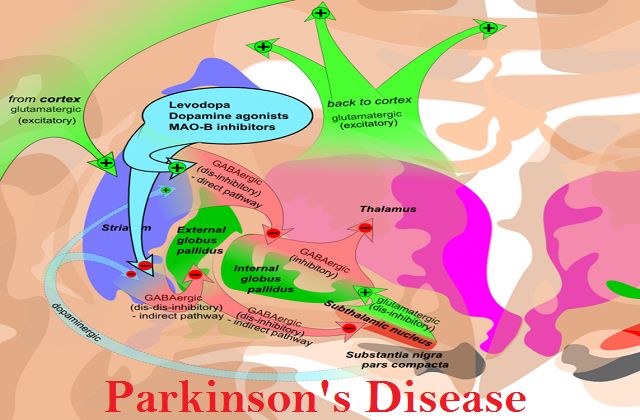 |
| Parkinson’s disease – a progressive, degenerative disorder of the central nervous system. Image Credit: Wikimedia Commons. Some changes are made in this image. |

Parkinson’s Disease: Symptoms, Causes, and Treatment | How to
Prevent Parkinson’s Disease
What is Parkinson’s disease?
is a neurological disorder in which the patient’s condition progresses and
worsens over time.
Parkinson’s disease affects a person’s mobility, ability to speak and
write, and is characterized by the appearance of abnormal physical movements on
the person.
The symptoms develop gradually; they may begin with very mild
tremors in one hand, and over time the symptoms become more obvious.
The person
with Parkinson’s disease suffers from slow movement, rigidity or
stiffness. In a survey, it is found that males are more likely to develop Parkinson’s disease than
females.
In most cases, symptoms begin to appear after age 50, but 4-5% of
Parkinson’s patients develop symptoms before they turn 40.
described “paralysis agitans” knew the disease clinically.
(adsbygoogle = window.adsbygoogle || []).push({});
Symptoms of Parkinson’s disease
Parkinson’s disease appear in the patient when the production of dopamine is
reduced by 75-80%, and this decrease leads to a disturbance between dopamine
and other chemicals in the base nuclei, such as Stericol, Glutamate.
Symptoms
of Parkinson’s disease vary from person to person, and often begin to appear on
one side of the body, followed by the other side later.
The following is the
main symptoms of Parkinson’s disease:
Tremor is one of the most common symptoms of Parkinson’s
disease.
Tremor usually begins at one end, often in the hand or
fingers and its appearance is shown very clearly at a time when the patient
relaxes and does not engage in any activity.
Bradykinesia (slow motion) is one of the most common symptoms that cause
disability and difficulty for the patient in the initial stages which hinders
some of his work and daily activity.
Parkinson’s disease reduces mobility and
slows it down, making simple tasks difficult and time-consuming, it takes a lot
of time and effort, and steps may be shorter when walking, and the patient may
have difficulty getting out of his seat.
is one of the primary motor symptoms of Parkinson’s disease, along with
bradykinesia and tremor.
Parkinson’s disease can lead to muscle stiffness,
causing pain and limiting the range of motion. The inability to relax causes
muscles to become stiff.
Postural instability (Loss of balance) is a major motor symptom of Parkinson’s
disease that usually appears in the late stages of the disease.
The patient may
have difficulty balancing and standing in a healthy position.
Literally: Dyskinesia literally is characterized by tics, twitches, and
spasms; by spasm of a group of muscles (dystonia), rapid, jerky movements
(chorea); more complex slow writhing movements (athetosis).
Involuntary movements
(dyskinesia) may affect different parts of the body such as the legs, arms, and
torso.
The patient’s ability to perform some spontaneous and involuntary
movements, including blinking, smiling, and swinging the arms when walking, may
be reduced. These symptoms appear when the levels of dopamine become too low.
Dysphagia: Dysarthria (difficulty speaking) and dysphagia (difficulty
swallowing) can be strongly determined for symptoms of Parkinson’s disease.
Speech problems caused by Parkinson’s disease are speaking quietly, or quickly,
or fluctuation, and hesitation before the speech. These cases can be assisted
by referral to the speech therapist.
(difficulty writing) is a secondary motor symptom of Parkinson’s disease.
The patient may have difficulty writing, and his line appears small.
It is
believed that micrographia (abnormally small or cramped handwriting) is a
result of bradykinesia (the loss of spontaneous movement).
The Stages of Parkinson’s Disease
to the development of Parkinson’s disease, that may include:
stage, a person suffers from mild symptoms of Parkinson’s disease that do not
generally interfere with his daily activities.
The symptoms occur only on
one side of the body. Some changes may occur in his walking, posture and
facial expressions.
this stage, symptoms of Parkinson’s disease begin to worsen, they can affect
both sides of the body.
During this stage, a person with the disease may
live alone, but daily activities can be difficult for him.
stage, a person with the disease falls more commonly. His movement slows down
and he usually loses his balance.
Symptoms significantly weaken his activities
such as eating foods and wearing clothes but he is still not completely
dependent on other people, he can do some activities even if very slowly and
insecurely.
this stage, the symptoms of Parkinson’s disease become acute, intensive and
deteriorating. The patient is unable to live alone, he needs help to carry out
his daily activities, such as walking, wearing clothes and eating foods.
During
this stage, it is possible for the patient to stand without any help, but
a walker may be needed to balance his movement.
most debilitating and advanced stage of Parkinson’s disease. The patient
requires around-the-clock nursing care for all his daily activities. The
person cannot stand in any way without assistance.
During this phase, it is
possible that the patient experiences hallucinations and delusions.
(adsbygoogle = window.adsbygoogle || []).push({});
Cause of Parkinson’s Disease
movements, through integrated regulation within the basal nuclei (basal
ganglia).
The nerve fibers are present and the inputs of these basal
nuclei are interconnected in a complex way.
When any part of the basal
nuclei in the human body is damaged, this is clearly reflected in the patient
such as involuntary movements of the person, muscle tension disorder, slow
movement, the nature of the patient’s stature in walking or even standing.
is caused by a lack of dopamine inside the brain, due to a disruption or damage
in the dopamine production in the substantia nigra (arcuate nucleus), which is
one of the basal nuclei at the base of the brain.
Dopamine is the chemical
transmitter that runs between neurons and contributes to the functioning and
transmission of neurotransmitters in order to achieve physical motor regularity
in humans.
Substantia nigra (black substance) is charged with the production of
dopamine in the brain.
Any movement we normally make is a product of the
interaction between the various parts of the brain, such as the pyramidal,
extrapyramidal, cerebellar balance, and so on.
that Parkinson’s disease is related to heredity in some people. This
disease can affect both men and women.
How is Parkinson’s Disease Treated?
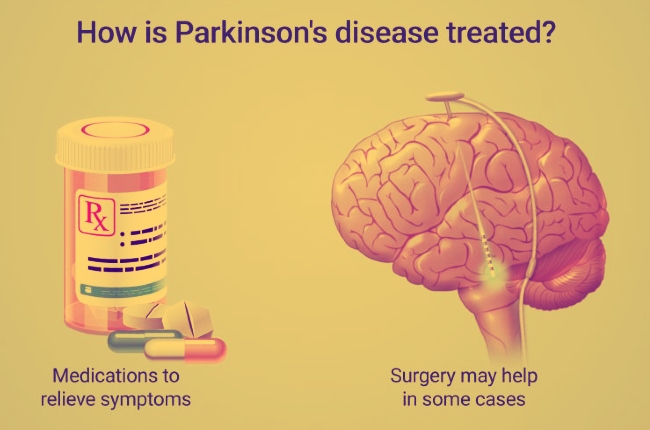 |
| The treatment of Parkinson’s disease is based on the types of symptoms. Effective treatment may include medication, physical exercise, and surgical therapy. |
Treatment of Parkinson’s Disease
cannot be cured, but medications can often help control symptoms significantly.
In some cases, the patient may need to undergo certain surgical procedures.
(adsbygoogle = window.adsbygoogle || []).push({});
Pharmacological Treatment of Parkinson’s Disease
control and control the problems of walking, movement, and
tremor.
Parkinson’s treatment relies mainly on increasing the
concentration of dopamine, an important neurotransmitter in the brain, whose
deficiency is associated with Parkinson’s disease.
Medications
significantly improve symptoms at the beginning of treatment, but the
effectiveness of medicines decreases as the disease progresses over time.
Medications
used to treat Parkinson’s Disease and tremor may include:
(Carbidopa-Levodopa): SINEMET® is used for the treatment of Parkinson’s
disease and syndrome. It is a combination of carbidopa and levodopa.
Levodopa
is the most effective treatment for tremor. Inside the brain, levodopa is
converted into dopamine, while added carbidopa reduces the side effects of
levodopa.
As the disease progresses, the effectiveness of levodopa may become
less stable, and the patient may experience involuntary physical movements
after high doses of levodopa.
agonists are less effective than levodopa but they work longer and can be used
in conjunction with levodopa to improve its effectiveness, especially during
periods when levodopa stops working.
Examples include Pramipexole and
Ropinirole.
The side effects of these medicines are similar to those of
levodopa.
Amantadine is used to relieve minor symptoms of Parkinson’s disease in the
early stages, and can be given along with levodopa during the later stages of
Parkinson’s disease to reduce its side effects.
(COMT) inhibitors: An example of this group is Entacapone, which prolongs
the action of levodopa by inhibiting the enzyme that breaks down
dopamine.
Side effects include increased risk of diarrhea and involuntary
physical movements.
Inhibitors: MAO-B inhibitors may include Selegiline, Rasagiline.
These
medications prevent the destruction of dopamine in the brain by inhibiting the
monoamine oxidase enzyme. They have some side effects such as nausea and
insomnia.
medications have been used for many years to contribute to the control of
tremor associated with Parkinson’s disease.
However, its modest benefits
and multiple side effects, such as memory impairment, constipation, dry mouth,
and difficulty urinating, have limited use in tremor treatment.
Examples
include benztropine and trihexyphenidyl.
informational purposes only; we do not recommend any type of medication.
Consult your doctor before taking any type of medicine for the treatment of Parkinson’s
disease.
(adsbygoogle = window.adsbygoogle || []).push({});
Surgical Treatments for Parkinson’s Disease
used in the treatment of Parkinson’s disease include:
Stimulation: In this surgery, electrodes are inserted into a specific area
of the brain, using MRI and recording the activity of brain cells during the
procedure.
A device that releases electrical impulses is also implanted
under the collarbone or in the abdomen, providing an electrical impulse to the
brain.
This procedure is usually used if pharmacological treatments fail
to alleviate the patient’s condition and at least four years after the disease.
Studies show that the process is useful for at least five years.
Deep brain
stimulation is more effective for people with disruptive shivers and some
side effects from the use of medications.
Therapy: Duopa therapy is a surgical procedure in which a small hole is
made in the stomach wall to place a tube that reaches the intestines.
The
tube is connected to a pump to deliver levodopa and carbidopa in the form of a
gel directly to the intestine through this tube instead of a pill.
This
method of treatment aims to improve absorption and to reduce the time periods
during which an oral medication does not work.
This surgical procedure is used to treat people with advanced Parkinson’s disease, which
responds well to levodopa, especially if the patient has daily fluctuations in
the movement that last for more than three hours and do not respond to
pharmacological treatments.
How to Prevent Parkinson’s Disease
ways to prevent Parkinson’s disease as the exact cause is unknown, even
then it can be prevented by:
environmental toxins as much as possible.
⇨Taking a short nap (15 to 30 minutes) after lunch.
head injuries.
exercise regularly
adequate rest.
and lack of enzymes, because proper nutrition is necessary to prevent the body
from diseases in general and brain injury in particular.
So it is advisable to
eat as much of the vegetables and fruits rich in dietary fiber, fish, and foods
with a high content of fatty acids and omega-3.
(adsbygoogle = window.adsbygoogle || []).push({});