Reflex Sympathetic Dystrophy (RSD), also known as Algodystrophy, is a type of complex regional pain syndrome (CRPS), characterized
by edema, erythema, functional impairment, vasomotor and sensory
disturbance.
RSD causes chronic pain, usually in an arm or leg, and it
appears after an injury, stroke, or even a heart attack.
Reflex sympathetic
dystrophy syndrome (RSDS) is a combination of symptoms: severe and specific
pain, localized swelling, limitation of movement of the organ, etc.
by edema, erythema, functional impairment, vasomotor and sensory
disturbance.
RSD causes chronic pain, usually in an arm or leg, and it
appears after an injury, stroke, or even a heart attack.
Reflex sympathetic
dystrophy syndrome (RSDS) is a combination of symptoms: severe and specific
pain, localized swelling, limitation of movement of the organ, etc.
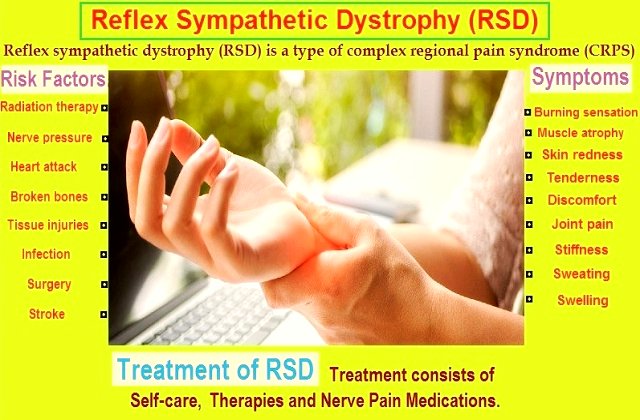 |
| Reflex Sympathetic Dystrophy (RSD) is a type of complex regional pain syndrome (CRPS) |
What is Reflex Sympathetic Dystrophy (RSD)? –
Symptoms, Causes and Treatment
What is Reflex Sympathetic Dystrophy (RSD)?
Reflex Sympathetic Dystrophy (RSD), also known as painful dystrophy
(Algodystrophy) or CRPS type 1, is a combination of various and varied symptoms, which is severe
and specific pain, the appearance of local swelling, limited range of motion in
arm or legs and disorders of enteric nervous system function with vascular
congestion and the occurrence of hyperhidrosis and cyanosis.
(Algodystrophy) or CRPS type 1, is a combination of various and varied symptoms, which is severe
and specific pain, the appearance of local swelling, limited range of motion in
arm or legs and disorders of enteric nervous system function with vascular
congestion and the occurrence of hyperhidrosis and cyanosis.
RSD syndrome is characterized by osteopenia. This phenomenon can be
seen by bone imaging, which shows the rate of Rapid Turnover of bone tissue, as
the rate of bone decomposition exceeds the frequency of construction.
seen by bone imaging, which shows the rate of Rapid Turnover of bone tissue, as
the rate of bone decomposition exceeds the frequency of construction.
RSDS takes many forms, depending on its location in the body, and
the circumstances of this syndrome. This disease appears, especially in
post-traumatic cases, for example, 7% -35% of patients with a fractured
wrist named Colles, as well as 5% -20% of patients after a heart attack and 5%
-20% of patients with cerebral palsy, in the paralyzed part of the
body.
The syndrome is not only present in a single joint, nor the
innervation area of a particular nerve, but by location in the body, such as
the end of the body.
the circumstances of this syndrome. This disease appears, especially in
post-traumatic cases, for example, 7% -35% of patients with a fractured
wrist named Colles, as well as 5% -20% of patients after a heart attack and 5%
-20% of patients with cerebral palsy, in the paralyzed part of the
body.
The syndrome is not only present in a single joint, nor the
innervation area of a particular nerve, but by location in the body, such as
the end of the body.
It is unclear how and why this syndrome develops. With a reciprocal
relationship between the nervous system and connective tissue, only in a few
cases in which patients suffer from severe disease.
relationship between the nervous system and connective tissue, only in a few
cases in which patients suffer from severe disease.
(adsbygoogle = window.adsbygoogle || []).push({});
Stages of Reflex Sympathetic Dystrophy
Reflex sympathetic dystrophy usually develops in three stages:
Stage I: severe pain, sometimes overnight, with allergies and local
swelling, just like inflammation. Disturbances in the function of the
independent nervous system appear in the affected area to varying degrees from
case to case. However, there are usually difficult functional disorders
in the patient at an early stage due to paralysis of the affected area and
acute pain.
swelling, just like inflammation. Disturbances in the function of the
independent nervous system appear in the affected area to varying degrees from
case to case. However, there are usually difficult functional disorders
in the patient at an early stage due to paralysis of the affected area and
acute pain.
Stage II: Lasts for about 3 – 6 months. The disease subsides, but
tissue atrophy – the skin and muscles – is obvious, and the skin becomes
thicker and softer (as in Scleroderma). Early curvature in the affected joints
also appears. At this stage, osteoporosis can be clearly seen by means of bone
imaging.
tissue atrophy – the skin and muscles – is obvious, and the skin becomes
thicker and softer (as in Scleroderma). Early curvature in the affected joints
also appears. At this stage, osteoporosis can be clearly seen by means of bone
imaging.
Stage III: This stage can take a very
long time, or even become a permanent phenomenon. It is about the
personality and psychological nature of the patient. There are soft tissue
shrinkage and atrophy with severe curvature contraction, accompanied by a
sense of psychological instability.
long time, or even become a permanent phenomenon. It is about the
personality and psychological nature of the patient. There are soft tissue
shrinkage and atrophy with severe curvature contraction, accompanied by a
sense of psychological instability.
Symptoms of Reflex Sympathetic Dystrophy
The symptoms of RSD syndrome are:
- Changes to the skin in the affected area.
- Sweating around the affected area.
- Pain or burning sensation.
Feeling warm to the touch.
Skin paleness with a blue tone.
Sensitivity to heat or cold.
Nail and hair changes
Joint pain and stiffness
Muscle atrophy
Muscle weakness.
Muscle spasms
Swelling.
Skin redness.
Tenderness.
Discomfort.- Soft tissue injuries such as burns and bruises.
- Trauma, such as broken bones, fractures, or
amputation. - Paralysis of one side of the body.
- Emotional stress.
- Radiation therapy.
- Nerve pressure.
- Heart attack.
- Stroke.
- Surgery.
- Infection.
- Sprains.
- Cancer.
Nonsteroidal anti-inflammatory drugs.
Tricyclic antidepressants (TCAs).
Anticonvulsants.Benzodiazepines.- Topical anesthetics.
Beta-blockers.- Systemic steroids.
- Membrane stabilizers.
Bisphosphonates.- Muscle relaxers.
- Vasodilators.
Guanethidine.
Opioids.- Interventions for reflex sympathetic dystrophy
syndrome (RSDS) include: - Spinal cord stimulation
- Deep brain stimulation
- Transcutaneous electrical nerve stimulation
- Intrathecal (in the spine) drug pumps
- Electroacupuncture
- Biofeedback
- Pump implantation
Peripheral nerve blocks
Sympathectomy, either surgical or chemical, which damages some of the
sympathetic nerves
(adsbygoogle = window.adsbygoogle || []).push({});
Causes of Reflex Sympathetic Dystrophy
The exact cause and mechanism of how RSD develops are
not well understood. Some theories such as abnormal excitation of nerve
tissue and irritation lead to abnormal impulses along the nerves that
affect blood vessels and skin. Several underlying conditions and factors
can trigger and lead to RSD, including:
not well understood. Some theories such as abnormal excitation of nerve
tissue and irritation lead to abnormal impulses along the nerves that
affect blood vessels and skin. Several underlying conditions and factors
can trigger and lead to RSD, including:
Treatment of Reflex Sympathetic Dystrophy
Treatment goals include pain relief, reduction of
tissue congestion, prevention of tissue contraction and treatment of anxiety
and depression in these patients.
tissue congestion, prevention of tissue contraction and treatment of anxiety
and depression in these patients.
Strong analgesics and long-term physiotherapy are
usually needed to activate the affected area.
usually needed to activate the affected area.
The fixation of the painful organ
should be avoided; hydrotherapy has been shown to be particularly effective.
In the acute phase, a moderate to high steroid dose
is given to reduce the high metabolic frequency.
is given to reduce the high metabolic frequency.
Calcitonin and other drugs that reduce osteoporosis,
where it is found effective, especially in the first or second stage, not only
by affecting the bones, but also in relieving pain.
where it is found effective, especially in the first or second stage, not only
by affecting the bones, but also in relieving pain.
Local blocking of the autonomic nervous system by
local anesthetics, as well as drugs that block receptors in the autonomic
nervous system, contribute to the reduction of pathological circulatory
interactions between connective tissues and this nervous system.
local anesthetics, as well as drugs that block receptors in the autonomic
nervous system, contribute to the reduction of pathological circulatory
interactions between connective tissues and this nervous system.
Intensive rehabilitation treatment, in the second and
third stage, is important in order to restore the proper functioning of the
patient.
third stage, is important in order to restore the proper functioning of the
patient.
(adsbygoogle = window.adsbygoogle || []).push({});
Medication
A variety of medications are available for RSD,
ranging from over-the-counter pain relievers and topical creams to prescription
drugs from your doctor. These medications include:
ranging from over-the-counter pain relievers and topical creams to prescription
drugs from your doctor. These medications include:
Medical procedures
(adsbygoogle = window.adsbygoogle || []).push({});