Human intelligence is a mental quality that consists of the ability to think, to learn from experience, to apply knowledge, to solve problems, and to adapt to new situations.
Intelligence
includes the ability to learn from experience, act purposefully, solve
problems, adapt to new situations, understand and handle abstract concepts, and
use knowledge to manipulate one’s environment.
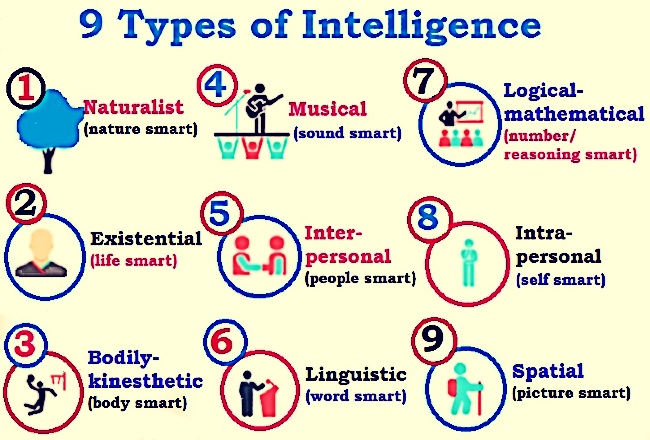
Howard Gardener, an American developmental psychologist, has described 9 types of intelligence:
1.
Naturalist Intelligence.
2. Musical
Intelligence.
3.
Logical-Mathematical Intelligence.
4.
Existential Intelligence.
5.
Interpersonal Intelligence.
6.
Bodily-kinesthetic Intelligence.
7.
Linguistic Intelligence.
8.
Intra-personal Intelligence.
9. Spatial
Intelligence.
Know What
Kind of Intelligence You Have.
 |
| Intelligence in psychology |
Intelligence in Psychology: Types and Characteristics – Know What Kind of Intelligence You Have
Definition of Intelligence
of intelligence differs from one person to another.
definition of intelligence but definitions can be collected that intelligence
is the ability to understand, to innovate, to learn, to collect, to think
abstractly.
is a speed of understanding and speed in the intuitive, intellectual and cognitive activity carried out by the mind.
of intelligence is an old concept. Philosophers rely on the method of
observation in interpreting intelligence. They follow the method of
self-introspection during the thinking processes or other mental activities.
and ideas, which philosophers reached only by observation, can only be adopted
and approved by subjecting them to scientific and experimental methods of
study.
maybe referred to other aspects, such as social, linguistic, and athletic
intelligence.
is characterized by one or more types of intelligence.
(adsbygoogle = window.adsbygoogle || []).push({});
What is Intelligence
in Psychology?
psychology, intelligence is a mental quality that includes the ability to think, learn from experience, adapt to new situations, apply knowledge and solve challenges and problems.
Intelligence is a kinetic sensory process with multiple and continuous capabilities that is activated and functioning after enhancing the genetic factor and predisposition with appropriate external stimuli.
is one of the qualities that distinguish people from each other and make one
more successful than the other.
wants to be intelligent to achieve what he wants.
necessary for intelligence to be linked to academic or systematic achievement
as it is known to some psychologists.
Characteristics of Intelligence
grows during the first five years of the child’s life rapidly, and then stops
at the age of sixteen to eighteen to twenty.
may stop at this age and remain constant, and may increase with the activity of
the intellectual person, and may decrease with progress in time if a person
stops learning, and does not practice intellectual activities.
is influenced by genetic factors. When the parents are intelligent, the IQ of
the child is increased. But this is also affected by the surrounding
environment; the environment that encourages intelligence must be provided.
is not one of the instinctive habits in man. Some believe
that intelligence is learning and learning is instinctive, but the concept of intelligence
is broad and learning is part of it.
and change is accepted in intelligence when appropriate activities are
available.
characteristics of intelligence may include:
is the capacity of a human being or the power of the human brain.
is a group of multiple forces in the overall form of truth.
is the power of good responses from the point of truth.
is the ability of abstract thinking and problem-solving.
is the ability to learn from past experiences and use past experiences
profitably.
is not knowledge, despite the fact that the acquisition of knowledge depends to
a large extent on intelligence.
What Kind of Intelligence Do You Have?
yourself? How far do you know it?
describe yourself as intelligent?
think you’re smart, do you realize your intelligence?
questions that concern every one of us, especially the parents because they are
worried when they find that their children are different in terms of
intelligence, educational attainment, and grades.
but why?
thought that intelligence is one type – an intellectual intelligence that relies
entirely on strong memory, concentration, and the ability to memorize and study
for long periods of time.
good news is that there is not one kind of intelligence, but rather a species.
words, the human being is the most intelligent and wise among all living beings
but there is really no competition in this world in terms of intelligence.
Everyone has his own field of intelligence. Yes, his intelligence may differ.
to reassure the parents and comfort them that their children are not stupid,
and at the same time encourage them to know the type and shape of the intelligence of their children, by knowing the types of intelligence.
reading this article, my reader will be able to classify the kind of
intelligence you have and your children or partner
help yourself to choose the form of education that suits you or suits your
loved one, gives you and gives them the largest amount of information with
minimal effort.
of your IQ is up to experience, science, culture, society, environment,
circumstances, and genetics.
How Many Types of Intelligence are There?
 |
| How many types of intelligence are there? |
Types of Intelligence
Gardner divided the intelligence into 9 types, identifying the characteristics
of each species and this was the most successful in dividing intelligence:
1. Naturalistic intelligence:
intelligence is the coexistence and adaptation to the natural environment, and
the identification of different natural varieties.
can be anyone who has the ability to discriminate among living things as well
as sensitivity to other features of the natural world.
a scientist who specializes in studying nature, a biologist whose interest lies
primarily in the study of plants or animals and even a child who is always
collecting butterflies and leaves and has the ability to discriminate between
them.
2. Linguistic Intelligence:
(word smart) is the ability to learn languages, whether spoken or written and
to use them in self-expression and in addressing any communication with others.
intelligence allows you to understand the meaning of words and apply
meta-linguistic skills to reflect on your use of language.
characteristic of writers and poets.
3. Logical-mathematical intelligence:
(number/reasoning smart) contains logical analysis and problem-solving,
scientific research, reasoning, deduction, and criticism.
who has logical-mathematical intelligence is smart at dealing with math and
logical problems and he always enjoys solving puzzles and reading scientific
discoveries and he wants to know how things work with computers and other devices in
general.
intelligence is characterized by mathematicians, scientists, engineers, and
detectives.
4. Musical Intelligence:
ability to recognize, distinguish and simulate tones, sounds, music, and
rhythms, pitch, and timbre.
create, reproduce, and reflect on music.
by musicians, vocalists, composers, conductors, and sensitive listeners.
5. Bodily-kinesthetic intelligence:
(body smart) is the ability to coordinate and harmonize the movements of the
body in order to achieve certain goals.
intelligence involves the perfection of skills and a sense of timing through
the mind-body union.
intelligence is characteristic of dancers, athletes, surgeons, and
craftspeople.
6. Interpersonal Intelligence:
Intelligence involves
the ability to mix and interact with others, work with them, influence them,
understand their desires and motivations,
Intelligence, also known as emotional intelligence (EI), emotional
quotient (EQ), and emotional leadership (EL), is the intelligence that
deals with human beings with different characteristics and qualities.
intelligence is spread among people actively, is keen to understand different
types, and has the ability to understand the psychological situations of many
people without speaking, and is accepted by many people of different nature,
because of emotional equivalence, and the ability to absorb different views,
without losing any of the different parties.
intelligent is very active in business and group games, as well as the
things that require leading people in a large project.
intelligence is usually characterized by leaders, teachers, mentors, and sales
representatives.
7. Intrapersonal Intelligence:
Intelligence involves understanding oneself and one’s thoughts and feelings and
recognizing oneself fully from motives, goals, and aspirations and using such
knowledge in planning and directing one’s life and drawing an effective model
of self character.
intelligence is evident in psychologists, philosophers, and spiritual leaders.
8. Spatial intelligence:
intelligence is the perception of spaces and regions and the ability to
estimate the size of space and shapes and the ability to comprehend
three-dimensional images.
abilities of spatial intelligent people may include:
- Spatial
reasoning - Mental
imagery - Active
imagination - Image
manipulation - Graphic and
artistic skills - Active
imagination
architects, pilots, sailors, and sculptors all exhibit spatial intelligence.
9. Existential intelligence:
intelligence is the sensitivity and ability to deal with deep questions about
human existence and the capacity to use collective values and intuition to
understand others and the world around them, such as the meaning of life, why
we die, etc.
The
Difference between Brain Functions and Intelligence
intelligence.
intelligence is not necessarily an important factor in maintaining effective
brain function.
differences in intelligence between men and women.
their brains faster to act and deal with problems.
better ability to analyze complex topics.
Conclusion
of multiple intelligences expanded the educational outlook of students and has
an impact and hustle in educational circles.
intelligence is more in the person because you know that everyone has a
dissonant part of all these types.
interested in the subject, so I have tried the tests several times, and
every time I got a different result because the choices of each test put you in
a certain position.
intelligence you have because you can often guess that the answer will get you
to a certain result – you might like to be your outcome.
that these tests may give you an overview of each intelligence. The choices in
the questions show an application for each of the nine kinds of intelligence.
for scientific purposes, this intelligence must be measured by several tools, direct observations, projects or practical applications, and
observing the impact of the surrounding environment.
it is possible to develop a “principled” perception of the type of
intelligence that dominates the person, which helps improve the quality of the
education.
(adsbygoogle = window.adsbygoogle || []).push({});