Nanotechnology
in electronics offers faster, smaller and more portable systems. Nanoelectronics increases the
capabilities of electronic devices, enhances the density of memory chips and
reduces power consumption and the size of transistors used in integrated
circuits.
Nanotechnology plays a significant role in communication engineering
and has a wide range of applications and can affect the telecommunications
industry in several ways. Let’s have a look at the applications of nanotechnology in electronics and communication engineering.
Applications of Nanotechnology in Electronics and Communication Engineering
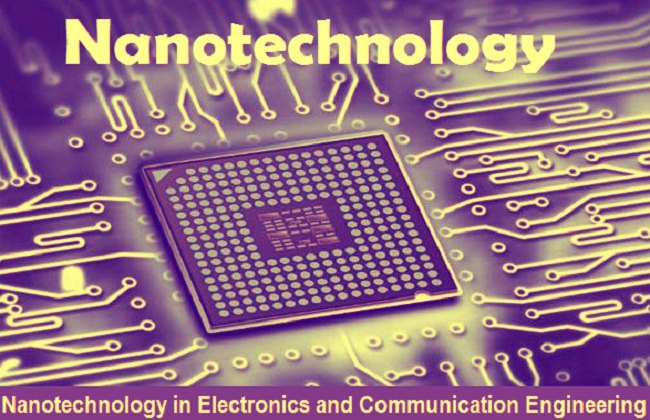 |
| Nanotechnology in electronics and communication engineering |
What is Nanotechnology?
measurement. Nano is equal to one-millionth of a millimeter. It is impossible
to see it with the naked eye or some simple magnifier. The nanoscale is used in
atomic measurements to determine the sizes of matter particles.
is a science that studies the possibility of changing matter at the nanoscale
level, in order to produce new materials or advanced devices to serve human
interests in various fields. Nanotechnology is also defined as the study of
very small things and the study of applications in which they are used.
Applications of Nanotechnology
Nanotechnology
is used in all areas of science such as chemistry, physics, biology, materials
science, and engineering.
The Nanotechnology Revolution contributed to creating an environment for joint work between chemists and other specialists in the fields of physics, biology, and engineering until it reached cooperation with material and industrial scientists so that scientists and specialists in every type of science could advance their science quickly.
It is necessary for them to understand the requirements of other sciences in order to arrive at a mechanism for efficient cooperation between them.
Nowadays, nanochemists are working in medical organic chemistry, polymer chemistry, product synthesis, and other fields. They rely on a wide range of options for preparing and creating nanomaterials with electronic, magnetic, photochemical and chemical properties, and their mechanical system is interpretable and explainable within the infinitesimal space, e.g., nanoscale.
For example, there are so-called semiconductors in
the world of microelectronics. Semiconductors are materials that combine
metallic and non-metallic properties.
This variation in physical and
chemical behavior can be used in favor of modern science, so here
nanotechnology is emerging in making these semi-conductors materials with
electronic properties by ejecting the metal alloys of these semiconductors –
such as the silicon element – for example, with atomically-precise
nanoparticles such as phosphorus particles, for example, to form diodes and
transistors.
They are the chips used in the manufacture of computers, CPUs, and
all electronic and electrical devices.
is used in many electronic devices such as laptops, computers, cell phones,
television, and digital cameras and also includes polymeric nano-films such as
organic light-emitting diodes (OLEDs).
Nanotechnology in
Electronics (Nanoelectronics)
Nanoelectronics
refers to the application of nanotechnology in electronic devices, especially
transistors.
Although the term nanotechnology means using technology less than
100 nanometers in size, nanoelectronics often refers to very small transistors,
so quantum mechanical properties and inter-atomic interactions are required to
be studied in-depth and extensively.
As a result, the current transistors do
not fall within the scope of that classification, although these devices are
manufactured using 45 nm and 32 nm technology.
is sometimes a controversial technology because the current candidates are
statistically significantly different from conventional transistors.
Some
nanoelectronic candidates include carbon nanotubes, silicon nanowires,
hybrid molecular/semiconductor electronics or advanced molecular electronics.
offers you smaller faster, and more portable systems. It increases the
capabilities of electronic devices, components, and integrated systems and
enhances the density of memory chips to manage and store larger amounts of data and information.
provides magnetic nanoparticles for data storage, printable and flexible
electronics and advanced display technologies with quantum computing and
conductive nanomaterials.
can improve display screens on electronic devices and revolutionize a lot of
electronic products, applications, and procedures and reduce their weight, power
consumption and the size of transistors used in integrated circuits.
Nanotechnology in Communication
Engineering
and communication technology (ICT) refers to advanced and innovative
technologies that provide access to information through telecommunications.
ICT
is an important and fast-growing industrial sector with a high rate of
innovation and covers any product that will store, manipulate, receive or
transmit information electronically in digital form.
Nanotechnology is
considered an industrial revolution for the telecommunications industry and has
led to tremendous changes in the telecommunications, networking and computing
industries.
plays a significant role in communication engineering and has a wide range of
applications and can affect the telecommunications industry in several ways.
Nanotechnology can revolutionize many aspects of information and communication
technologies and their features.
also plays an important role in telecommunications engineering and can provide
effective solutions for human-machine interaction, memory enhancement program,
power-efficient computing, sensing, and controlling the physical world with
computers.
one wants to interact with other human environments such as home, office,
public places, he needs an effective way of communication.
Electronic devices
with a high degree of computation and communication technologies provide him
better computing and sensing resources and an intelligent way of communication.
is manufacturing many new materials and electronic devices, which have a huge
range of applications.
It can help produce computer chips and sensors that are
significantly smaller, more energy-efficient, faster and cheaper than their
current counterparts.
Conclusion:
in electronics and communication engineering. Examples include silicon nanowires, carbon nanotubes (CNT), supercapacitor (SC),
actuators, computer chips, and sensors.
>