CPV technology uses optical instruments such as curved mirrors or lenses to focus a large amount of sunlight onto a small area of multi-junction (MJ) solar cells (photovoltaic panels) to generate electricity.
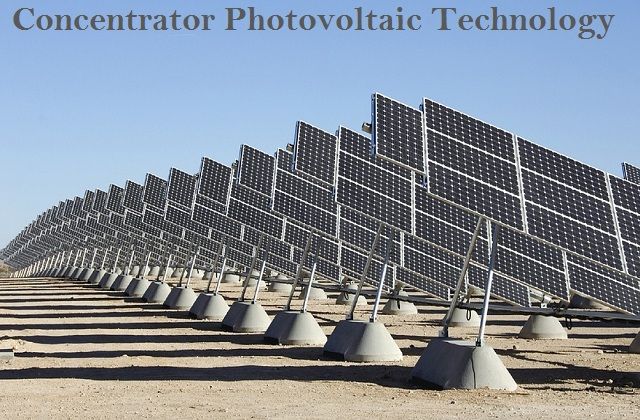 |
| Concentrator photovoltaic (CPV) solar technology which will shape the future of solar energy |
What is Concentrator
Photovoltaic (CPV) Technology? – Benefits and Challenges
(CPV) systems can reduce the cost of solar cells because of the reduced space
required for photovoltaic materials.
Concentrator photovoltaic (CPV) technology has many benefits but
there are some challenges regarding manufacturing costs and other perspectives.
What is Concentrator Photovoltaic (CPV)?
photovoltaic technology that uses optical instruments such as lenses or curved
mirrors to concentrate a large amount of sunlight onto a small area of highly
efficient photovoltaic (PV) (multi-junction-MJ) solar cells and converts
visible light into direct current (DC) electricity.
Because of the low amount
of photovoltaic materials required, concentrator photovoltaic technologies can
use the most cost-effective tandem solar cells.
measured in “suns” (the square of the magnification).
Concentrator photovoltaic
(CPV) systems can be regarded as telescopes oriented towards the position of
the sun, feeding the cell with concentrated light.
In CPV system designs, the
magnification ratio varies considerably, it has been developed into three
categories: • + Low concentration (LCPV), where the magnification ratio is less
than 10X. • + Medium concentration (MCPV), between 10X and 100X. • + High
concentration, where the ratio is higher than 100X but is usually less
than X 1000.
(adsbygoogle = window.adsbygoogle || []).push({});
Concentrator Photovoltaics vs.
Conventional Photovoltaics
(CPV) system converts optical energy into electrical energy in the same
way as conventional photovoltaic technology.
The difference between concentrator
photovoltaic technology and conventional photovoltaic technology is the
addition of an optical instrument system in CPV technology to focus a large
amount of sunlight on each cell.
In order to concentrate sunlight on the
limited area of photovoltaic panels, concentrator photovoltaic systems require
more money to be spent on concentrated optical instruments (lenses or mirrors)
and sometimes on solar tracking and cooling systems.
Because of these
additional costs, concentrator photovoltaic (CPV) technology is currently much
less common than non-concentrated solar modules.
Concentrator
photovoltaics technology is increasingly recognized as the most promising
technology to meet the energy challenges facing the world.
panels have become a recognized science since the 1970s, but have only recently
become commercially marketable, the latest technology in solar energy
sector.
Benefits of Concentrator Photovoltaic
(CPV) Technology
commercial benefit generated by concentrating photovoltaic technology is
mainly due to the huge energy yield of these cells, especially in
high-radiation areas.
This benefit is also due to the large potential of these
cells in reducing costs compared not only with other solar technologies but
also with other renewable energy sources.
These characteristics can make
the concentrator photovoltaics technologies the most widely used solar carriers
in future power plants.
The solar added value represents a high degree of technical
specialization in understanding CPV technologies and functional
principles.
Concentrating photovoltaics (CPV) modules typically use
multi-junction (MJ) solar cells. These cells are actually composed of many
solar cells – called sub-cells – connected in series and made of different
semiconductors.
is that it allows increased energy use from photons in the solar spectrum,
providing the system with a higher degree of conversion of light into DC
electricity.
Furthermore, multi-junction (MJ) solar cells can be especially
designed and calibrated for a specific optical spectrum in order to perform a
more efficient light conversion.
multi-junction cell (MJ) is the three-link cell, which typically exhibits
a conversion rate efficiency of more than 40 percent, which is much higher than
any other commercially used photovoltaic panel technology.
focus instrument and a solar cell. With the exception of very low
concentrations, a solar tracking system is also essential.
Low
concentration systems often include a simple reflection booster that can
increase solar electricity production by more than 30 percent of photovoltaic
systems without concentrations.
(adsbygoogle = window.adsbygoogle || []).push({});
Challenges Regarding Concentrator
Photovoltaic Technology
technologies are to get CPV products out of the laboratory and take them to
market.
The most important thing that will make CPV technology successful or
fail is the ability to manufacture products in the required quantity while
keeping costs down.
systems, the optical light concentrators are used to increase the incidental
capacity of solar cells.
The semiconductor properties allow solar cells to operate
more efficiently in concentrated light, as long as the temperature of the cell
junction is maintained by appropriate heat sinks.
The solar cell area is
relatively small, thus requires the use of more sophisticated, more expensive,
multi-junction solar cells and the systems need careful tracking to keep the
light focused on solar cells as the sun moves during the day.
This adds
additional system costs and complexities and also increases the maintenance
load during operation.
photovoltaic products, they face many challenges because the photovoltaic process requires the use of advanced materials, optical alignment of various
stages with micrometer precision, the integration of microscopic systems in
large areas, the manipulation, and interconnection of thousands of elements per
square meter.
Therefore, alternative renewable energy storage
technologies should be explored to achieve small CPV units at low manufacturing
cost.
multi-junction photovoltaic cells are currently 44 percent efficient and
are constantly increasing to 50 percent in the coming years.
Scientific
journals are full of reports on recent developments in solar cell efficiency.
Although this is very encouraging, it is difficult to know how well these
innovations are doing outside the laboratory and when they will succeed in the
market.
The concentrating photovoltaic technology market seems ready to
take off and grow rapidly due to feed-in tariff laws adopted in many sunny countries.
(adsbygoogle = window.adsbygoogle || []).push({});