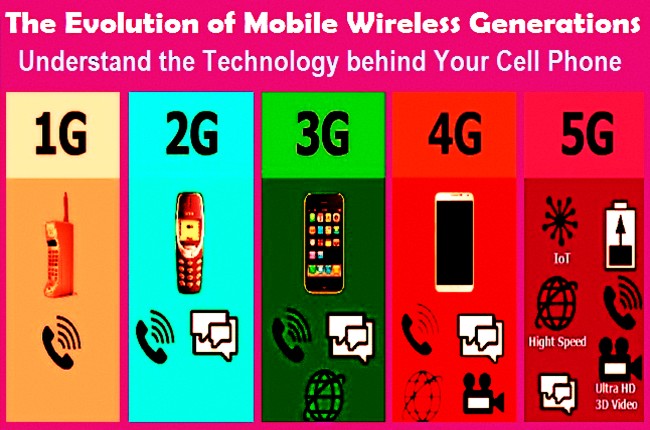
 |
| The evolution of wireless generations from 0G to 5G – Understand the technology behind your cell phone |
0G,1G, 2G, 3G, 4G and 5G- The Evolution of Wireless Generations – Understand the Technology behind Your Cell Phone
The Evolution of Mobile Wireless
Generations
So far, we have explained how the communication network works in general, let us talk about the generations of mobile wireless technology that we have seen during the last 40 years.
The current demand for mobile communication requires the integration of wireless technologies into existing networks such as wide area networks (WANs), local area networks (LANs), etc.
In this article, we have discussed the evolution of mobile generation technologies from 0G to 1G, 2G, 3G, 4G, and 5G.
(adsbygoogle = window.adsbygoogle || []).push({});
0G Wireless technology
generation mobile technology (0G) refers to pre-cell phone mobile telephony
technology, such as radiotelephone, which some had in cars before the arrival
of cell phones.
0G was the predecessor of the first generation of cellular telephones.
1G: Analog Cellular Networks
1st generation of wireless cellular technology. Mobile telecommunications were
introduced with 1G technology in the 1980s. 1G is analog technology and
supports voice-only calls.
1G Analog Cellular Network
Features
Characteristic: First wireless communication
Analog telecommunication (30KHz)
150MHz / 900MHz
(data rate): 2kbps
Analog cellular
using 1G technology had:
quality
life
(adsbygoogle = window.adsbygoogle || []).push({});
2G: Digital Networks
2nd-generation of wireless cellular technology. 2G cellular networks took place
in Finland in 1991 on the GSM standard.
1991, the world’s first GSM phone call was introduced by Radiolinja GSM operator
from analog to digital communications.
call and text encryption, along with data services such as SMS, MMS and picture
messages.
2G Mobile Phones Features
Digital telecommunication
1.8GHz (900MHz)
(data rate): 64kbps
900MHz (25MHz)
Digital cellular, GSM
2.5G and
2.75G
is a new packet-switching technology between the second and third generations. 2.5G is more efficient than 2G technology
that led to 2.75G networks. 2.5G capability is usually associated with General
Packet Radio Services (GPRS).
2.5G Features
cellular technology with GPRS
phones
browsing
Key Differences Between 1G and 2G
used by 1G technology are analog, while 2G wireless technologies are digital
that allow voice and data communication services such as text message services.
(adsbygoogle = window.adsbygoogle || []).push({});
3G: High-Speed IP Data Networks
an ITU specification for the 3rd generation of wireless mobile
telecommunications technology.
telecommunication was first introduced in May 2001 as a pre-release of W-CDMA
technology. on 1 October 2001, the 3G network was launched commercially by NTT
DoCoMo in Japan.
is the upgrade for 2.5G and 2.5G GPRS networks, and it promises increased
bandwidth and faster data transfer speed.
work over wireless air interfaces such as GSM, CDMA, and TDMA as well as the
EDGE air interface.
3G Network Features
Characteristic: Digital broadband, increased speed, fast communication, video
calls.
1.6 – 2.0 GHz
100MHz
(data rate): 144kbps – 2Mbps
CDMA, UMTS, EDGE
What is the difference between 2G and 3G networks?
The main difference between 2G and 3G networks is that GSM (2G) can provide voice and video communication using GPRS, while 3G provides high-speed internet, high-speed video communication, video conferencing, etc.
The data transmission rate on a GSM (2G) network is 200-300 Kbps, while the downloading speed can go up to 42Mbps in 3G networks.
Overall, 3G networks are much better and work faster than the 2G network.
4G: Growth of Mobile Broadband
4th generation of broadband mobile communication technology, which was released
in 2008. On December 14, 2009, 4G was
launched commercially in the world by TeliaSonera telecom operator.
technology supports mobile web access with more advanced features. The 4G network provides capabilities defined by ITU in IMT Advanced.
technology also offers video conferencing, HD mobile TV, 3D TV, gaming services
and other features that demand high speeds.
Fourth-Generation Long Term
Evolution (4G LTE)
refers to the fourth generation long term evolution that provides a more
reliable and fastest connection and higher speeds to mobile Internet
experience-10 times faster than 3G. It is worth noting that 4G is faster than
LTE.
Voice over LTE (VoLTE)
long-term evolution (VoLTE) is a specification of wireless technology product that defines
data transfer speed rates and standards and complete data transfer procedures for delivering voice communication
over 4G LTE networks.
4G Network Features
characteristic: High speed, all IP
battery usage
high security
100MHz
– 8 GHz
(data rate): 100Mbps – 1Gbps
LTE, WiFi
mobile support
personal service
What is the difference between 3G and 4G technology?
The primary difference between 3G and 4G networks is speed. 4G speed is ten times faster than 3G.
The 3G network provides 21 Mbps data bandwidth while 4G offers 1 Gbps maximum data bandwidth and brings broadband to your phone.
3G technology uses a wide-area cell-based network while 4G technology uses a hybrid network architecture.
3G technology uses packet switching for data transmission while 4G technology uses both packet and message switching.
3G networks employ code-division multiple access (CDMA) while 4G networks utilize orthogonal frequency division multiple access (OFDMA).
(adsbygoogle = window.adsbygoogle || []).push({});
5G Wireless Technology: The
Next-Gen Network
5th generation wireless communication technology for digital cellular networks.
It is expected that 5G networks can be smarter, faster and more efficient than
4G networks.
technology may use a variety of spectrum bands and can provide mobile data
speeds up to 100 gigabits per second.
5G Technology Features
and capacity
transmission than 4G
(data rate): 1Gbps – UNLIMITED
Supports
streaming
Internet
(adsbygoogle = window.adsbygoogle || []).push({});