Insects are a variety of vertebrate animals in the Division of
Arthropods, the broadest and most comprehensive classification in the
arthropods division. Scientists of Darmstadt University of Applied Sciences and
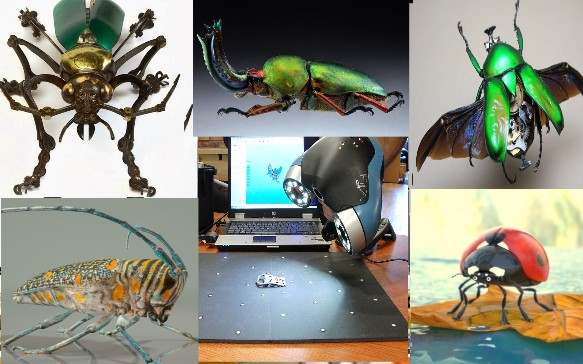
TU Darmstadt jointly developed a novel scanner, which digitizes protected worms
in high resolution and protected insects.
Arthropods, the broadest and most comprehensive classification in the
arthropods division. Scientists of Darmstadt University of Applied Sciences and
TU Darmstadt jointly developed a novel scanner, which digitizes protected worms
in high resolution and protected insects.
 |
| 3D Scanner for insects |
Scientist Developed 3-D Scanner for Insects
Scanning Insects in 3D
Insects are a variety of vertebrate animals in the Division of
Arthropods, the most widespread and most widespread classification in the
Division of Arthropods.
Insects form the most diverse group of living organisms
on earth. They contain more than one million species described – more than half
of all living organisms. The number of unclassified species is estimated to be
around 30 million, or more than 90% of all life forms.
Insects exist in almost
all environments, but only a small number have been used to live in the aquatic
environment, the type of housing controlled by another range of arthropods,
crustaceans.
Arthropods, the most widespread and most widespread classification in the
Division of Arthropods.
Insects form the most diverse group of living organisms
on earth. They contain more than one million species described – more than half
of all living organisms. The number of unclassified species is estimated to be
around 30 million, or more than 90% of all life forms.
Insects exist in almost
all environments, but only a small number have been used to live in the aquatic
environment, the type of housing controlled by another range of arthropods,
crustaceans.
There are many tools and scanners to recognize insects and their
family, one of them is a 3D scanner, here we have discussed new development
regarding a 3D scanner.
family, one of them is a 3D scanner, here we have discussed new development
regarding a 3D scanner.
The earliest known fossils are from an insect found in sediments
dating to the Devonian age.
The fossils reached 396 million years ago,
after the Scottish village of Rainey, which was found nearby; By the Latin name
“Rhyniognatha hirsti”. This species of insects had a two-section
falcon, a phenomenon that appears in winged insects.
It is assumed that the
wings of the insects had evolved and appeared at that time. This means that the
winged insects appeared earlier, probably in the Silurian era.
dating to the Devonian age.
The fossils reached 396 million years ago,
after the Scottish village of Rainey, which was found nearby; By the Latin name
“Rhyniognatha hirsti”. This species of insects had a two-section
falcon, a phenomenon that appears in winged insects.
It is assumed that the
wings of the insects had evolved and appeared at that time. This means that the
winged insects appeared earlier, probably in the Silurian era.
(adsbygoogle = window.adsbygoogle || []).push({});
Capturing natural-color 3D models of insects
Insects were one of the first terrestrial grasses to be found on
the plant, and this has played a role in the qualitative evolution of some
species.
The plants have developed some chemical defense methods to protect themselves
from insects. In turn, insects developed certain mechanisms so as not to be
affected by plant toxins.
Many insects use these toxins to protect themselves
from predators. Such insects declare their poison by warning colors. Plants
protect themselves in a different way as they evolved to resemble flower
leaves, trees or even twigs to protect themselves from predators. This
technique is known as “imitation” or “imitation”.
This
relationship between plants and insects has led to the development of multiple
and intricately complex species.
Some relationships between plants and insects
are beneficial for both parties (such as pollination where the plant is
fertilized and the insect absorbs enough food), and the co-evolution has led to
the emergence of some very special reciprocal couplings in such a relationship.
the plant, and this has played a role in the qualitative evolution of some
species.
The plants have developed some chemical defense methods to protect themselves
from insects. In turn, insects developed certain mechanisms so as not to be
affected by plant toxins.
Many insects use these toxins to protect themselves
from predators. Such insects declare their poison by warning colors. Plants
protect themselves in a different way as they evolved to resemble flower
leaves, trees or even twigs to protect themselves from predators. This
technique is known as “imitation” or “imitation”.
This
relationship between plants and insects has led to the development of multiple
and intricately complex species.
Some relationships between plants and insects
are beneficial for both parties (such as pollination where the plant is
fertilized and the insect absorbs enough food), and the co-evolution has led to
the emergence of some very special reciprocal couplings in such a relationship.
Scientists of Darmstadt University of Applied Sciences and TU Darmstadt jointly
developed a novel scanner, which digitizes protected worms in high resolution
and protected insects.
The scanner should make an important contribution to the digital document of
biodiversity. Because protected insects in the collection are also in danger.
The documentation and understanding of the local and global diversity of
insects is thus a particularly immediate concern.
There has been a tremendous
lack of insects in the past decades: Some of the country’s protected areas have
lost 75 percent of their insect biomass. Due to natural decay and insects like
the Museum Beetle, they are threatened to lose gradually.
More than one million different species are stored in natural history museums –
a large number. Digitization is not possible for them to be preserved for the
future, but it is also possible to reach online worldwide.
An ecologist Michael Heethoff explained, “Although there are already many
photographic documents of pest collections, the reduction in bi-dimensional
images of three-dimensional animals are extremely unsatisfactory.” Single
images make it impossible to see all important characters, and some Spatial
relationships of character cannot be displayed. “
That’s why a 3-D insect scanner was needed. Here, Bernhard Strobel of the
Department of Mathematics and Natural Sciences of Darmstadt University of
Applied Sciences came into play with his many year’s experiences in the field
of optical 3-D measurements.
It took four years for the combined development of “DISC 3D”
(Darmstadt insect scanner 3-D) device. In TU Darmstadt, the group examines the
effects of land use and climate change on the communities of “ecological
networks” species and the characteristics and characteristics of insects
and articulates.
Bernhard Ströbel said that “In order to allow imaging from all directions, the
insect is rotated by stepper motors at regular intervals around two axes. As a
result, there are approximately 400,000 digital single images, which meet 400
different local directions.
These 400 images produce three-dimensional models for which the photographic
surface of insects is applied digitally. The results are correct for colors,
3-D models of animals have been scaled, which can be seen, rotated, zoomed, and
curated in museums.
The scanner can make images of most sizes in its current configuration, the size of a cock chief of animals with two millimeters
small flies
The model can be enhanced and printed with a 3-D printer, which is also
interested in museum education for example.
Although the device currently uses commercial software, it is in principle
designed as an open project that interested parties can be realized by
themselves. Some museums and research institutes have already expressed
interest in the scanner and started making reproductions.
Developers are expecting many simulators, including private individuals, to
achieve the goal of digitizing large-scale pest collection in museums. On
request, the interested parties are provided the construction plan of the
device, and hopefully due to participation in further development.
Journal Preference: Phys.org
(adsbygoogle = window.adsbygoogle || []).push({});